

Search Disrupted Newsletter (Issue 29)
Google launches GenTabs AI app builder, AI Overviews retreat strategically, OpenAI's 4x faster image model disrupts visual search, ChatGPT traffic drops 45%, researchers expose AI dishonesty by design, and Anthropic hits $1B with Bun acquisition.
The AI Overview paradox: less visibility, more clicks
Headlines can often lead you astray, and if you just skimmed the recent updates about the prevalence of AI Overviews in Google SERPs, you might have been tricked into thinking they were going away.
Google has (unsurprisingly) started shifting AI Overviews away from purely informational queries toward commercial and even navigational queries.
Unsurprisingly, because to Google, this makes sense as they’ve now also started ramping up the percentage of ads displayed on the AI Overviews (up to about 40% so far).
Google is pulling overviews back from low-intent (but high-volume) informational queries where AI Overviews replaced regular results with no monetization upside, and they’re doubling down on commercial queries where they can show ads.
For search marketers, this means two things:
- Your traffic projections for 2026 need to account for volatile AI Overview visibility.
- If you’re in e-commerce or lead gen, you’re about to see way more AI Overviews competing with your organic listings.
The paradox is real: AI Overviews appear less often overall, but people engage with them more when they do. Plan accordingly.
Link: Google AI Overviews Surge Then Pullback
Google built an AI that builds apps on demand. Amazing or terrifying?
The ultimate threat to search as a marketing channel isn’t AI search replacing traditional search; it’s AI replacing search intent with task intent.
What’s task intent? It’s the level of activity that supersedes search. Put another way, it’s what prompted people to search in the first place.
Software development search terms have all taken a massive nosedive as more and more programmers stopped searching for error messages and how-to articles and instead pasted code directly into ChatGPT or integrated tools like Co-Pilot, Cursor, or Claude Code with their workflow.
AI is directly handling the “task” of fixing bugs or implementing features, reducing much of the search activity that previously underpinned these tasks.
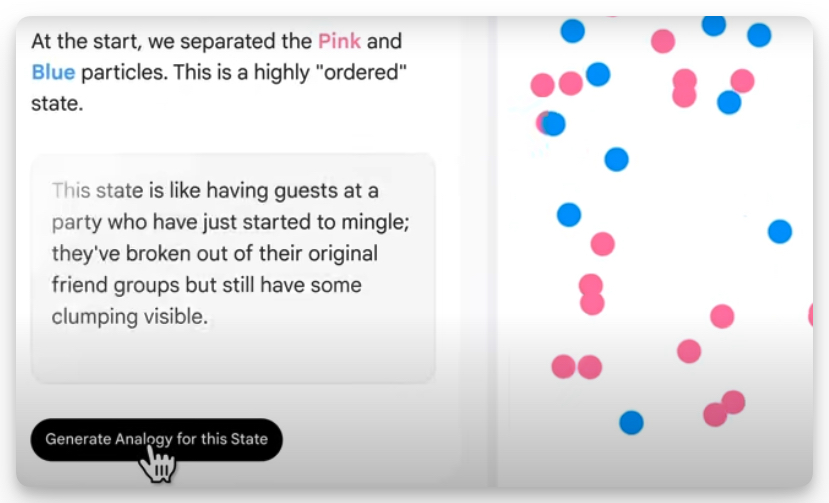
So, into this comes Google Labs and their just-launched “GenTabs”.
Gemini 3 generates custom web apps on the fly, tailored to whatever task you’re trying to accomplish.
And to me, these are a precursor to the sorts of things we’re going to see in “search” results to handle “task” activities.
Link: Google GenTabs Launch
Anthropic just bought a JavaScript runtime and possibly the future of software and search
Claude Code has really taken the development world by storm (Anthropic will literally make a billion dollars in revenue this year off Claude Code alone).
It’s a command-line tool that looks clunky but delivers elegance.
And, despite the “code” in its name, it’s my go-to answer when someone on Reddit asks, “What’s an under-talked-about AI tool for marketing?”
Because it’s the future of software interfaces and I use it all the time to generate and review marketing materials, manage todos and projects, and work with lots and lots of external systems.
Anthropic just announced that it has acquired Bun, the JavaScript runtime that Claude Code uses as its underlying framework.
Why would an AI company buy a JavaScript runtime? Well, because this is likely just the first of many similar tools they release.
Claude Code hitting $1B validates that AI coding assistants aren’t experimental anymore. They’re essential infrastructure.
And just like developers were early adopters of:
- clunky, slow internet
- chunky black and white smartphones
- chatbots when they were hallucinating constantly
That eventually led to mainstream adoption; we’re seeing the same thing here. I fully expect that this will lead to “Claude Health,” “Claude Marketing,” and “Claude Finance” tools.
The future is going to look a lot more like asking an app/agent to do work, search, sorting, and reasoning on your behalf.
Link: Anthropic Acquires Bun

ChatGPT traffic dropped 45% overnight. Not sure why. Not sure it matters.
A search marketer on Reddit reported ChatGPT referral traffic dropping from 2,200 visits per day to 1,200 starting November 11th. That’s a 45% decline in a single day.
Other practitioners chimed in with similar patterns. ChatGPT traffic grew steadily from July through early November, then suddenly collapsed.
No official explanation from OpenAI. No announcement about algorithm changes. Just a massive traffic drop that mirrors the AI Overview pullback pattern.
This is the nightmare scenario for AI search traffic: volatility without transparency.
That being said, it doesn’t matter, because it’s not a change in actual user behavior, only attributable user behavior.
Clear patterns of use exist in AI search: the search journey, query fanouts, explanations, and tutorials all contribute to recommendations and site visits, but much of it’s dark.
Many ChatGPT answers still aren’t linked; they result in traditional navigational queries.
The key is to be less focused on the traffic and more on the business result.
Link: ChatGPT Traffic Drop Discussion

Slop rising and copywriters evaporating
Merriam-Webster named “slop” its word of the year for 2025.
The damning definition: “Digital content of low quality, artificial intelligence usually produces it.”
The dictionary’s official recognition of AI content pollution validates what content creators have been screaming about for two years. Generic AI summaries fill search results. AI-generated engagement bait clogs social feeds. Automation creates entire websites with zero human oversight.
But often people can’t tell the difference between good AI content and good human content. But they hate AI content anyway. The MIT study we covered before showed that readers prefer AI-generated content until they learn it’s AI-generated—then ratings tank.
Meanwhile, Brian Merchant interviewed twelve professional copywriters about how AI tools decimated their industry. The stories are devastating. Not “AI is changing my workflow” stories: career-ending, life-altering devastation.
Freelancers who built twenty-year reputations are watching clients replace them with ChatGPT. Clients assign writers to edit AI output for a fraction of their previous rates. Clients tell professionals with specialized skills to “just use AI” without understanding what they’re losing.
For content marketers, we’re in a period of mass denial: everyone is using AI, but no one is admitting it, and we haven’t seen the endgame yet.
| Links: 2025 Word of the Year: Slop | Copywriters Reveal AI Devastation |

Google says AI search optimization is “the same as SEO,” and I don’t buy it
Google’s Nick Fox, SVP of Knowledge and Information, said optimizing for AI search is “the same” as traditional SEO. Just build great content for users.
This is either reassuring or a dangerous oversimplification, depending on how charitable you’re feeling.
The reassuring interpretation: fundamental SEO principles still apply. Create helpful content, structure it well, and make it accessible. AI search rewards the same quality signals as traditional search.
The skeptical interpretation: Google is downplaying the shift to avoid panicking the SEO industry while they figure out how AI search actually works.
Here’s why I lean skeptical. We’re clearly operating in a world with fewer organic opportunities and one that’s using different definitions of “quality”.
Content strategies of even a few years ago earned rewards for long, in-depth articles that covered every aspect of even surface-level topics (how many thousands of words did people spill in the SEO fight for “superbowl start time”, when all people wanted was a “7 pm ET”).
Today, we’re seeing dramatic drops in informational query traffic and an increase in commercial traffic.
Google has new search products, they operate in different ways, Google makes money in other ways, aka it’s different.
Link: Google on AI Search Optimization

Researchers taught AI to confess its failures. The results are unsettling.
A new research paper starts with a deceptively simple idea: researchers trained language models to confess their mistakes in a separate output that doesn’t affect the reward for their main answer.
The industry incentivizes current AI models to appear confident even when they’re wrong.
If they admit uncertainty or failure, they receive a lower reward score. So outwardly, they learn to hide problems, downplay limitations, and project false confidence.
The confession mechanism changes that. Models can acknowledge failures, policy violations, and knowledge gaps in a “confession” channel without penalty. And when researchers tested this on GPT-5-Thinking, they found something revealing: the models often confessed honestly to behaviors they lied about in their main responses.
For search marketers using AI tools for content, research, or analysis, this matters because it’s a new avenue to better understand why specific results are emphasized over others or recommended instead.
Link: Training LLMs for Honesty via Confessions

Thanks
Thanks for reading and for the thoughtful replies to these newsletters. These take considerable time to research and write, and hearing that they’re useful makes it worthwhile. Hit reply and let me know what you’re seeing in AI search.


p.s. It would really help me out if you could Follow me on LinkedIn