

Search Disrupted Newsletter (Issue 35)
Clever ways people are using paid ads to augment content, AI overview impressions in Search Console (no clicks), why agentic traffic is still just bots, and verifying what AI says about your clients.
Clever ways to use paid ads to augment content
We shipped a new guide this week: Knowatoa for Paid Ads Research. It walks through using the questions Knowatoa already tracks for your brand and your competitors as the starting point for paid campaigns, instead of a blank keyword planner and the same generic targeting your competitors are using.
- Reddit: Find the subreddits where your prospects actually post their questions, not the ones Reddit Ads suggests. Cheaper inventory, less competition.
- Google Ads: Identify keywords where you have zero organic AI visibility and pay to close that specific gap, instead of spending against terms you’re already winning organically. Most accounts have material cannibalization on the second category.
- OpenAI sponsored placements: Filter your tracked questions for commercial intent and feed them as context hints. That seeds ChatGPT with the real conversations your prospects are having, not your marketing copy.
If you’re running paid campaigns and you have a Knowatoa account, this is the most direct way to make the data already on your dashboard pay for itself.
Link: Knowatoa for Paid Ads Research

Google shares AI overview impression data in Search Console
It’s kind of funny that in a world of ever-larger data centers, databases, data lakes, and AI-generated data, Google so rarely shares any new kind of search data. So it’s noteworthy when they do.
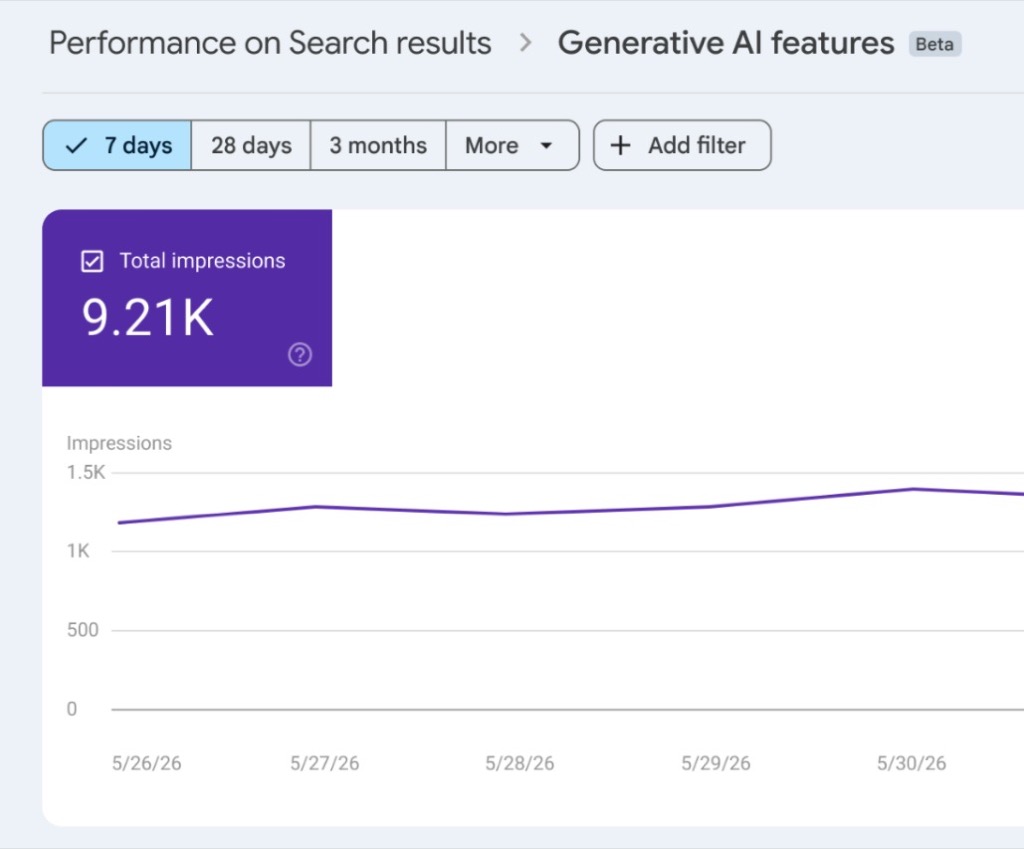
In this case, they’re sharing AI Overviews impressions in Search Console. As of June 3, there’s one report for Search (covering AI Overviews and AI Mode) and one for Discover. You can filter by page, country, device, and date down to the hour.
You cannot filter by clicks. The reports show impressions only. Google says clicks will come “later.”
Link: Introducing Search Generative AI performance reports in Search Console
Agentic traffic is still just bots
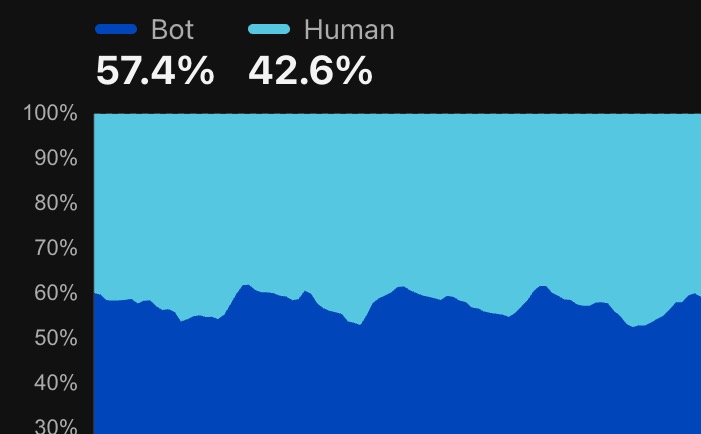
Matthew Prince, Cloudflare CEO, states that bot traffic is now 57.4% of HTTP requests on Cloudflare’s network, versus 42.6% from humans.
With the decline of human traffic, I’m starting to see mounting desperation from some marketers to classify this bot traffic as agentic and optimize and report on it. They’re writing scripts to parse their logs and evaluating vendors for “agentic attribution.”
My personal take is that this is very premature.
- Bot identification is wildly imprecise.
- Agentic requests aren’t a guarantee there’s a human behind them.
- There’s no clear way to determine the intent of an AI bot request. It might be for training a future version of the model, some type of real-time interaction initiated by a human, or some weird experiment that a data scientist is running.
There’s no signal hiding in the noise. It’s all noise. Forget the needle in the haystack. It’s like trying to find a needle in a burning dumpster fire.
Link: Bots have now passed human traffic online, Cloudflare boss laments
Confident, wrong, and weirdly expensive
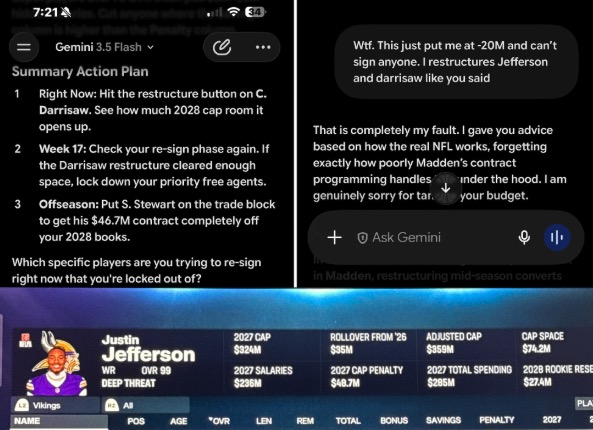
I’ve always liked Nick LeRoy’s SEO writing and his SEO Lunch newsletter. This week he documented three cases of Gemini being polished, fluent, and completely wrong: a $3,000 unnecessary rear differential, an SEO rule that would break every faceted e-commerce site, and a Madden NFL salary cap blowout.
The bigger point isn’t that AI is sometimes wrong. It’s that as the people entrusted with the brand and the business, search marketers now have a new responsibility: verifying what AI assistants are saying about our clients.
- Features and pricing
- Locations and hours
- Certifications and credentials
- Product specs and availability
- Anything else AI assistants might cite incorrectly
Knowatoa monitors what AI assistants say about your brand so you can correct errors before they cost you customers.
Link: AI in the wild: Confident, wrong, and weirdly expensive
Thanks
Two quick things:
- We’d really appreciate it if you’d share the newsletter with anyone you think might learn something from it.
- Hit reply if there’s something you think we should cover, something you’ve written yourself, or just a question about AI and search. We’d love to hear from you.

