

Search Disrupted Newsletter (Issue 37)
Why AI hallucinations and Reddit manipulation share a root cause, Lily Ray's data on listicles recommending competitors 69% of the time, the Pew 60% AI-summary number is a floor, the 30-second test for AI Mode landing pages, and Google's two AI tracks: search vs. agent tooling like OKF.
Reddit Influence, Manipulation, and Strategy
I see a lot of overlap between AI model hallucinations and the new paper that was just released on UGC and Reddit manipulation. Hallucinations are caused by a lack of data, and manipulation works for the same reason. The basis of both is that it’s “easy” to get cited and mentioned in AI places when there’s no competition for those terms.
This is just one more metaphorical orange upvote for prioritizing UGC content as part of your search effort.
Deep-research agents cite user-generated content in roughly half of all queries, and nearly a quarter of all citations come from UGC sites. One comment on a frequently-retrieved page can shape outputs for a whole cluster of related questions. The job of the search marketer now is to fill those gaps first, with accurate, structured information about the brands and sites you work on, before someone else writes the version that gets cited.
Link: It Is Trivially Easy to Use Reddit to Manipulate AI Search, Research Suggests

The listicle-with-yourself-at-#1 was always a bad trade
Years ago I ran DemandGen at an enterprise cybersecurity company that was genuinely best in class for their niche, and we explicitly didn’t publish side-by-side comparisons with competitors.
The minute you line yourself up next to four other vendors in a “best of” table, you’ve conceded you’re one of five interchangeable options.
At the time, we were making a content judgment call about what we were telling the market: that we were doing something unique and better than our competitors, and we shouldn’t be lumped into the same box.
Lily Ray’s new study is the AI-era confirmation. She looked at 80 B2B “best [category] software” prompts that triggered AI Overviews. Self-promotional listicles got cited 323 times. In 69% of those, Google cited the brand’s own “we’re the best” article and then recommended a competitor.
For “best LMS for selling courses,” Google cited Oasis LMS’s own listicle and then recommended Kajabi, Thinkific, and LearnWorlds. Same pattern across categories.
The two thoughts you want to sear into your brain are:
- Get cited and get recommended aren’t the same outcome.
- Content strategy is more than just search representation.
Link: Why Calling Yourself the ‘Best’ Could Be Helping Your Competitors Win in AI Search
Research confirms that everybody is reading AI Overviews
Most people, unsurprisingly, are not search professionals. They don’t parse a SERP finely enough to tell an AI Overview from a featured snippet, a knowledge panel, or a “People also ask” box. They’re all just gray boxes Google puts above the links.
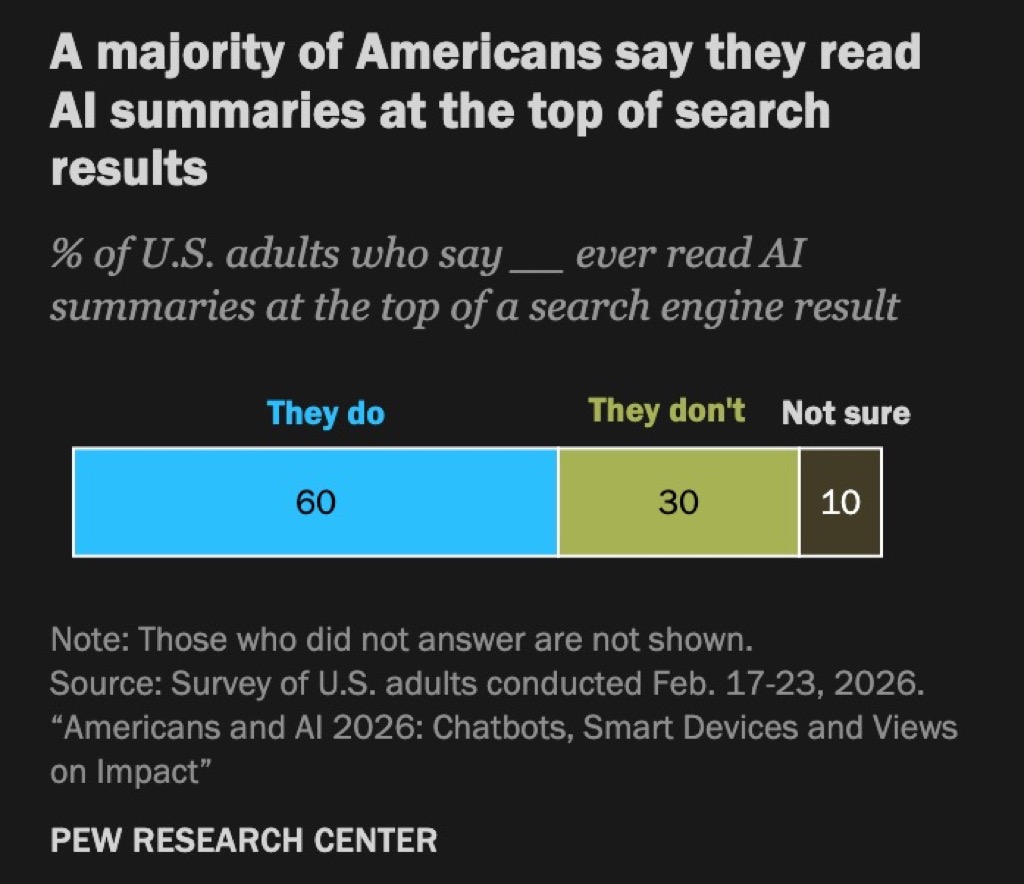
Which is why I interpret Pew’s reporting that 60% of people read the AI summary as the absolute minimum number. 30% said they don’t, and 10% weren’t sure. A meaningful share of that “no” is almost certainly reading AI Overviews and not recognizing them. In reality, the functional number is everybody (or as we say in Virginia, all y’all).
Google made AI Overviews the default above the blue links. The adoption argument was settled in Mountain View. AI search is the default Google result, and if you’re tracking it as a side project, you’re way behind the curve.
Link: Americans and AI 2026: Chatbots, Smart Devices and Views on Impact
Your landing page is wrong for Google AI Mode
Can a visitor complete the task they came for on your site within 30 seconds of landing?
If not, the page is built for the wrong era of traffic. Slobodan Manic in Search Engine Journal calls this the 30-second test, and it’s the right one to ask. The visitor coming in from AI Mode behaves differently from a Google organic click.
AI Mode queries run roughly triple the length of traditional search queries, planning-related queries are growing 80% faster than AI Mode overall, and AI-referred retail traffic converts 42% above non-AI traffic. Fewer visitors, longer questions, higher intent.
When someone clicks through from an AI Mode research session, they’re not at “awareness,” they’re at “do the thing”: verifying one claim or completing one task before their patience runs out. The practical change is unglamorous. Push the task-completion surface (booking widget, price, the specific fact) above the fold, and treat the hero as a confirmation screen, not a sales pitch.
Link: AI Mode Sends A Different Visitor. Your Website Wasn’t Built For Them
Don’t be fooled by Google’s other AI track
There are two different things happening at Google right now and search marketers keep mashing them together:
- Track 1 is search: AI Overviews, AI Mode, ranking shifts, the stuff that lands in your GSC reports.
- Track 2 is the broader AI tooling Google ships for developers and data teams: Gemini, Vertex AI, BigQuery, agents.
Both can touch a website, but they are not the same conversation, and most of what gets called “AEO news” actually belongs to one or the other.
The Open Knowledge Format is Track 2. Google Cloud shipped v0.1 on June 12: markdown files with YAML frontmatter in nested folders. Publish your tables, metric definitions, and runbooks as an OKF bundle so an agent can read your schemas and business definitions instead of guessing.
It’s explicitly a format for describing applications, how they’re configured, and their internals so a site reliability engineer at 3am can hand them to an AI and figure out why a system is down.
These Track 2 general-purpose AI tools like OKF and llms.txt are interesting because they point to not-yet-realized but possible future aspects of search that are more agentic, or potential future strategies. In most cases, though, they’re not a slam-dunk secret for improving your site’s visibility in search today.
Link: How the Open Knowledge Format can improve data sharing
Thanks
Thanks this week to Jessica Malnik. If you’re looking for other really interesting takes on AI and marketing, we’d recommend her Remote Work Tribe newsletter and podcast.

