


Sources and Citations in AI Search
Understanding how AI search engines use sources and citations, and how to optimize your content to become a cited reference.
What are citations and sources in the AI world?
Because the field is so new, a significant issue is that nobody is consistently saying exactly what “sources” and “citations” mean in the context of AI search.
But there’s really two things we’re concerned with:
- What URLs are being placed directly in the AI response? (what we will call “citations”)
- What URLs are influencing the AI response? (what we will call “sources”)
But the most important thing to keep in mind is that what we’re really after are mentions of your brand or your product in the AI response (visibility) and that these mentions have a positive sentiment.
What’s the relation to backlinks in the traditional SEO world?
It’s tempting to draw a direct line between sources/citations and backlinks in the traditional SEO world.
But it’s inaccurate for one very important reason: backlinks vary in importance based on the quality of the linking site (domain rating, page rating, quality, topic authority, etc.) which is not currently a factor in an AI model’s decision making.
The most consistent ranking factor in AI search is repetition of mentions not the quality of the linking site.
Put another way, it can make a big difference in your traditional SEO rankings if you’re linked from the New York Times vs a random mention on LinkedIn. But generally speaking, that won’t make a difference in your AI search visibility.
In traditional SEO, backlinks were votes of confidence. The more high-quality sites linked to you, the higher you ranked. The relationship was straightforward.

AI citations are more complex:
1. Inconsistent attribution
AI services don’t always cite their sources, even when they reference specific information. Sometimes you’ll be mentioned with a citation, sometimes without, even in similar queries.
2. Citation doesn’t guarantee visibility
Being cited as a source doesn’t always mean you’re recommended. AI might cite your content while recommending competitors, or cite you for background information without mentioning your product.
3. Source diversity matters
AI services pull from multiple source types: news sites, social media, reference materials like Wikipedia, e-commerce platforms, and company websites. Your citation profile needs breadth, not just depth in one category.
4. Temporal effects
Citations can be recent or historical. AI might cite a three-year-old article Reddit post because the overall numbers of citations are thin. Or newer content might be highlighted due to directions from the system prompt.
You can’t directly control which sources AI cites. You can only influence the likelihood by creating citation-worthy content and establishing presence across the source types AI values.
How do you get cited more by AI search engines?
Building a strong citation profile requires understanding current citation patterns, identifying gaps, benchmarking against competitors, and monitoring citation changes over time.
1. Map Your Current Citation Profile
Run a free Knowatoa site report to see which sources AI services are citing when they mention your brand or industry. The report you get initially will cover a snapshot of your current citation profile, but the 7 day free trial.
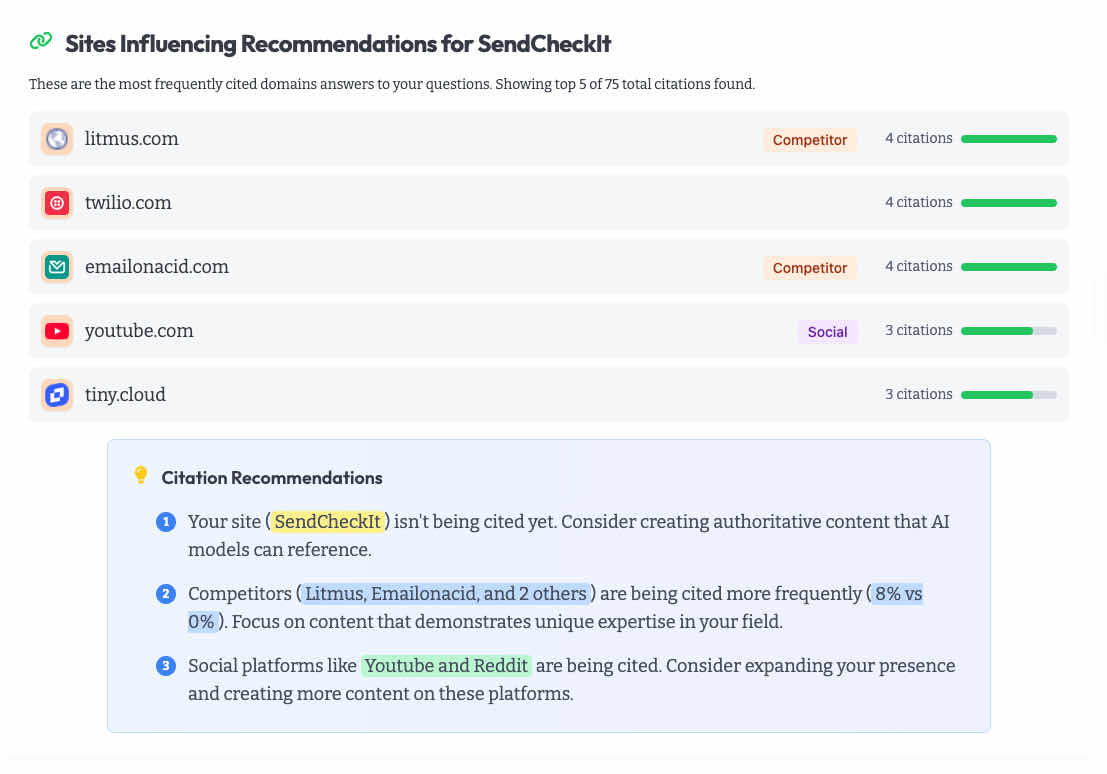
2. Build Citation Presence Across Source Types
Different types of citations serve different purposes in AI search:
Company website citations: These establish your official perspective. Create clear, comprehensive pages about what you do, your features, pricing, and use cases. Make this content easily findable and authoritative.
News and media citations: Coverage in credible news outlets like New York Times, BBC, or CNN carries significant weight. PR efforts that result in news mentions create strong citation signals for AI services.
Social media citations: Reddit discussions, Twitter (X), and LinkedIn posts influence AI perception, particularly for sentiment and user experience questions. Participate authentically in these communities.
This is something you can do right now.
Reference citations: Getting mentioned in Wikipedia, industry glossaries, or authoritative reference materials establishes you as a recognized entity in your space.
Review and comparison citations: Presence on platforms like G2, Trustpilot, or industry-specific review sites creates citations AI uses for evaluation and comparison queries.
3. Monitor Citation Changes Over Time
Citations aren’t static. They shift as new content is published, older content becomes less relevant, and AI models update their source preferences.
Track citation patterns regularly: - Which sources are newly citing you? - Are citations increasing or decreasing for specific content? - Which competitor citations are emerging as threats? - Are you being cited for the right reasons, or are citations misrepresenting your brand?
Understanding citation trends helps you identify content opportunities and catch misinformation early.
Next Step: Learn how to benchmark your performance against competitors → Continue to Competitive Benchmarking