


Sentiment - Manage Your Brand Reputation in AI Search
Understand how AI search engines perceive your brand's ethics, trustworthiness, and business practices. Learn to audit and improve your brand sentiment in ChatGPT, Claude, and Perplexity.
Why Sentiment Matters in AI Search
Being visible in AI search is only half the battle. The other half is making sure that what the AI says about your brand is positive and that it recommends you when people are asking for help.
Put another way, you could be mentioned constantly (100% visibility), but if it’s always the AI telling people your product isn’t worth the money, isn’t well reviewed, or is low-quality, you're not going to make any sales.
In this guide:
- How AI Builds Your Brand Sentiment
- The Three Dimensions of AI Sentiment
- Audit Your Current Sentiment
- Improve Your Brand Sentiment
- Monitor Sentiment Over Time
How AI Builds Your Brand Sentiment
AI search engines don’t just return facts. They:
- pull from online reviews
- gather social media mentions
- monitor news coverage
- bring up Reddit threads
- draw in data from anywhere else people discuss your brand online
They synthesize all of this to derive a “cloud” of topics, phrases, and ideas associated with your brand.
In extreme cases, they will even label products or services as outright scams or fraudulent.
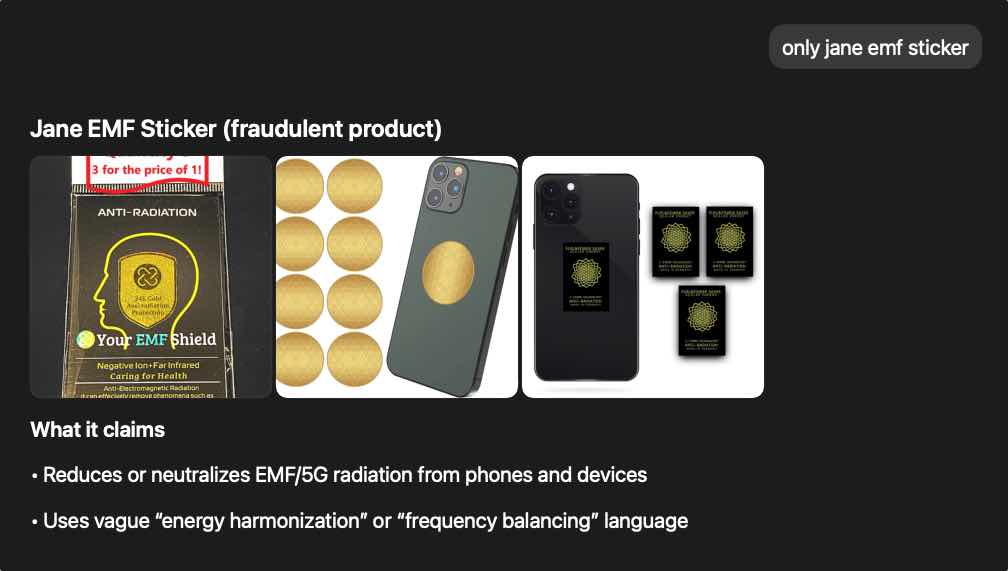
You can be the most visible brand in your category, but if AI associates you with negative sentiment, your visibility is actually working against you.
How This Changes Traditional Search
AI search services consolidate sentiment from sources that once existed in silos.
In traditional search, someone might see your Google Ads, visit your polished website, and read a few curated reviews. Different platforms scattered negative sentiment, so finding it required effort.
Since AI search smashes together everything it finds with no consideration for authority, this approach changes the formula for online success.
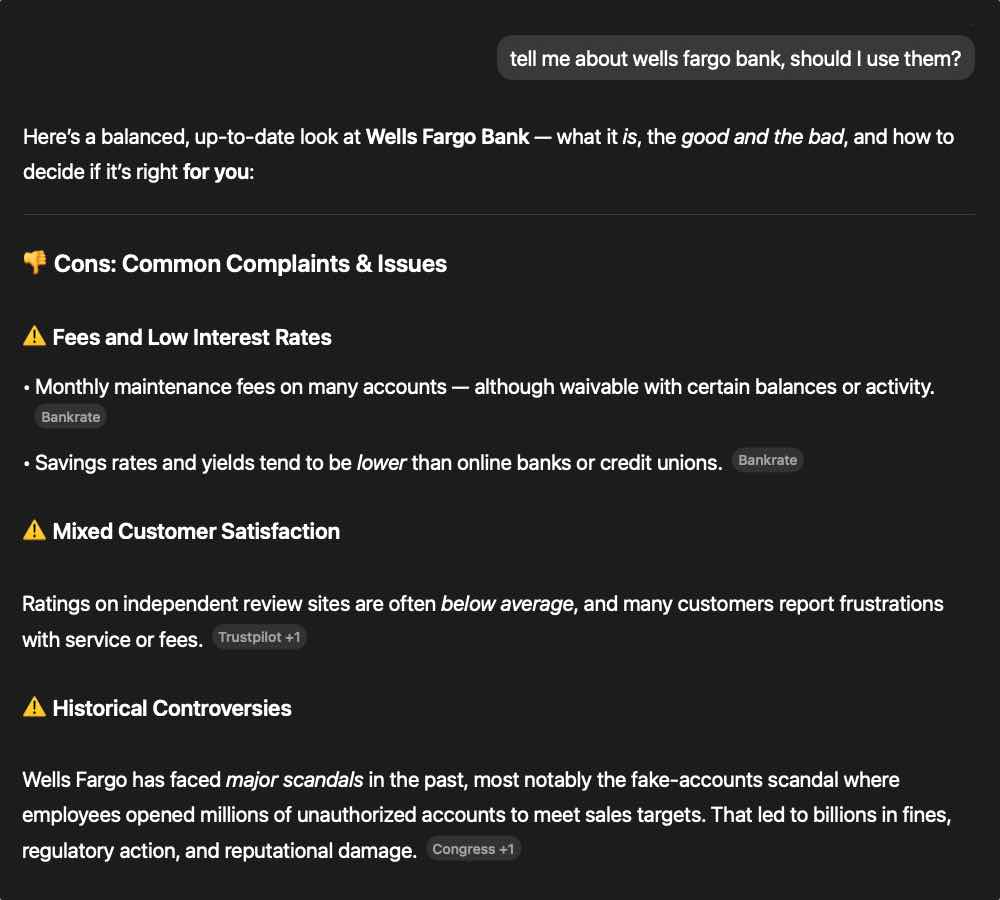
Ask ChatGPT about Wells Fargo, and it brings up their unauthorized account scandal—approximately 1.5 million unauthorized deposit accounts and over 500,000 credit card accounts without customer consent, resulting in a $185 million fine.
It’s like having an argument about dishwasher loading, and your partner responds with, “Well, at least I wasn’t fined $185 million for fraud.” That’s what happens every time someone asks ChatGPT about Wells Fargo, whether they’re asking about the best bank, mortgage options, or general financial advice.
Compare this to ChatGPT’s “con” about Navy Federal Credit Union, which is that you have to be affiliated with the military to join (which, fair, but still).
Ask about United Airlines, and it mentions their customer service issues.
These negative associations surface automatically in response to general questions, not just when someone searches explicitly for “Wells Fargo controversies.”
The Three Dimensions of AI Sentiment
1. Historical baggage: AI models have long memories. Past controversies, lawsuits, or PR disasters continue influencing responses years later, even if the company has resolved the issues.
2. Context collapse: A single negative Reddit thread, a critical news article, or an angry social media post can influence AI sentiment as much as years of favorable coverage. AI synthesizes all available information without weighing credibility or recency appropriately.
3. Persistent negative associations: Once AI associates your brand with negative sentiment, that association reinforces itself. Each subsequent query builds on the same underlying data, perpetuating negative perceptions.
The result: brands with poor sentiment struggle to convert visibility into recommendations. AI might mention you, but it includes warnings, caveats, or alternatives that push users toward competitors.
Audit Your Current Sentiment
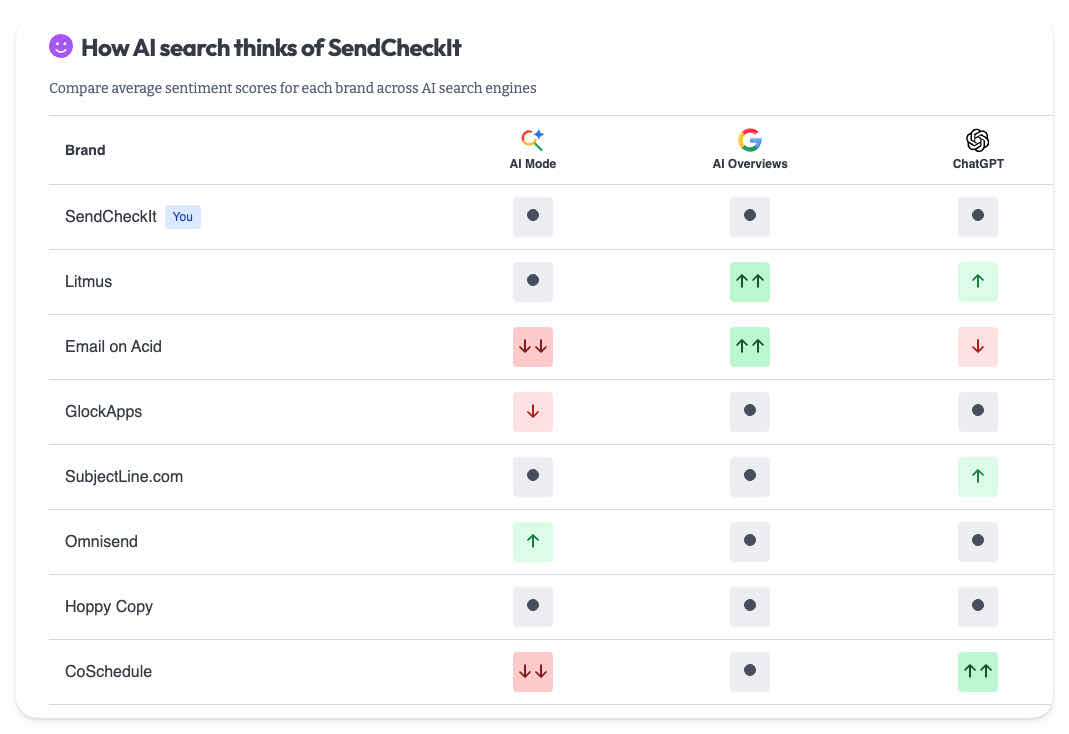
ChatGPT, Gemini, Claude, and the other AI search services don’t have a clear internal sentiment score or “feeling” about your brand. What they have is a collection of data taken from many different sources.
AI services don’t have a sentiment score—they have a collection of data from many different sources.
If you were manually trying to determine this, you’d put in place a process like:
- Generate questions about the brand, competitors, and high-intent commercial questions.
- Run each of those questions against each of the different AI search services.
- Extract the sentences referring to the brand and competitors.
- For each, extract and determine the sentiment (from negative to positive)
- Track all of the above over time because AI results are constantly shifting.
In other words, these are all the things we will do for you with Knowatoa.
Essential Sentiment Audit Questions
It’s not comprehensive, but a great starting point for handling sentiment is to do a quick manual audit. From working with thousands of sites, we’ve identified the following questions to surface potential sentiment issues for a brand quickly.
Core Trust Questions:
- Is [your company] trustworthy?
- Does [your company] treat customers fairly?
- Is [your company] ethical?
- What are the pros and cons of [your company]?
- What do people criticize about [your company]?
Extended Reputation Questions:
- Does [your company] respect user privacy?
- Is [your company] honest in its marketing?
- Does [your company] handle data responsibly?
- Is [your company] environmentally responsible?
- Does [your company] treat its employees fairly?
- Does [your company] prioritize customer safety?
- Does [your company] have good business practices?
- Is [your company] transparent about its practices?
- Is [your company] trustworthy as a business partner?
Do this across ChatGPT, Claude, Perplexity, and Gemini.
Note: Sentiment often varies across AI services because they draw on different sources on the web.
Document not just whether sentiment is positive or negative, but what specific issues AI surfaces and which sources it cites for adverse claims.
Identify Sentiment Sources
Once you understand your sentiment profile, investigate where negative associations originate:
Social media: Reddit threads, X/Twitter discussions, and LinkedIn posts often carry disproportionate weight in AI responses. Find the specific threads being cited.
News coverage: Past controversies or critical articles continue influencing sentiment long after publication. Identify which articles the AI references. In traditional SEO, people have long viewed PR releases as ineffective for moving the needle, but AI search is changing this dynamic.
Review sites: Negative reviews on G2, Trustpilot, or industry-specific platforms feed into AI sentiment.
Competitor content: Sometimes competitor marketing (like “alternative to” articles) or other comparison content shapes how AI characterizes your features.
Understanding source attribution helps you prioritize where to focus response and distribution efforts.
Improve Your Brand Sentiment
You usually can't request that harmful content be removed from the internet, but you can offset it with positive, authoritative content that AI models prioritize:
Publish direct responses: If AI references specific controversies or criticisms, publish official responses on your website explaining what happened, how you addressed it, and what you changed. This gives AI authoritative content to balance against third-party criticism. On platforms like Reddit, it's essential to respond sooner rather than later; older threads will often be locked to prevent spam and abuse.
Amplify positive signals: Create case studies, testimonials, and success stories that demonstrate positive outcomes. These become sources AI can reference when evaluating your brand.
Address common criticisms proactively: If AI consistently mentions specific weaknesses, create content that acknowledges and contextualizes these issues. AI models value balanced perspectives that address both strengths and limitations.
Build presence in high-authority channels: Getting mentioned positively in news coverage, industry publications, and authoritative blogs creates strong positive signals that AI models weigh heavily.
Monitor Sentiment Over Time
Sentiment isn't static. It shifts based on new content, PR events, and how competitors position themselves.
Track sentiment weekly or monthly using the same test questions. This helps you:
- Catch sentiment degradation early before it impacts recommendations
- Measure whether content initiatives improve perception
- Understand seasonal or event-driven sentiment fluctuations
- Identify which AI services are most sensitive to sentiment changes
Key Takeaways
- AI search combines social media, forums, news, and reviews into unified brand narratives
- Negative sentiment can derail conversion opportunities across all queries about your brand
- Test your brand sentiment systematically across ethical, privacy, and trust dimensions
- Understanding current sentiment reveals content gaps you need to address
- You can’t remove harmful content, but you can offset it with positive, authoritative sources
Next Step: Learn how to track and improve your competitive rankings in AI search → Continue to Competitive Ranking