


The AI Search Optimization Loop
A practical guide to improving your visibility in ChatGPT, Perplexity, Claude, and other AI search engines. Measure, optimize, and track your AI search strategy.
How to figure out where you stand, identify what steps need to happen and then take action to improve your visibility in AI search.
This guide focuses on the core optimization loop you’ll use to continuously improve your AI search visibility.
Before starting, make sure you’ve read Before You Start: AI Search Prerequisites—it covers what “AI search” actually means, why not all searches are equal, and the foundation you need in place.
You might also want to read our B.I.S.C.U.I.T. framework which helps to frame the larger picture of AI search optimization.
The AI search optimization loop
We’re using the term “AI search” here, but this is really the same series of actions you would take in traditional search. What’s changing is:
- The type of content you’re creating
- The type of questions and intents you’re trying to answer for your prospects
- How some of the steps are completed
- What you prioritize with your content and distribution efforts
Improving your AI search visibility is a continuous cycle. Things are changing rapidly, search is fracturing into many new channels, and the entire industry has become a moving target.
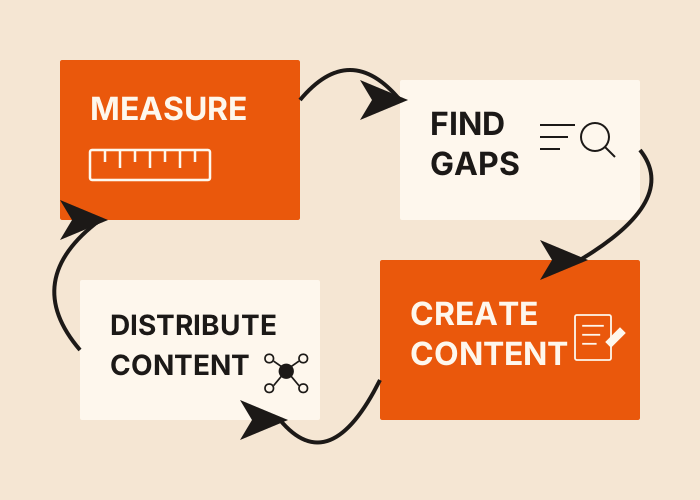
The loop has four steps:
- Measure your current performance
- Identify gaps and opportunities
- Create content to fill those gaps
- Distribute that content strategically
Then you repeat. Each cycle builds on the last, compounding your visibility over time.
Step 1: Measure Your Current Performance
You can’t improve what you don’t measure. Before optimizing anything, establish your baseline across these key metrics:
Visibility score: What percentage of relevant queries surface your brand? Visibility has become the foundational metric in search for the simple reason that you’re not going to be part of the conversation if you’re not even in the room.
Share of voice: When AI mentions brands in your category, how often is yours included versus competitors?
You're not going to be part of the conversation if you're not even in the room.
Sentiment: When you are mentioned, is the tone positive, neutral, or negative? Learn more about how sentiment affects your AI search visibility.
Citation rate: Are AI models citing your content as a source? Which pages? See our guide on sources and citations in AI search.
Knowatoa tracks all of these metrics across ChatGPT, Claude, Perplexity, Gemini, and other AI services. Run a free AI brand monitoring report to see where you stand today.
Focus your measurement on high-intent queries that actually influence decisions. For a deeper dive, see our guide on what questions you should track.
Step 2: Identify Gaps and Opportunities
With your baseline data, analyze where you’re underperforming and where opportunities exist. There are four types of gaps to look for:
Visibility Gaps
You’re not showing up at all
| Gap | Action |
|---|---|
| Competitors appear in high buying intent queries | Create content that directly answers why your product is the best solution |
| Not appearing for your own brand queries | Build foundational pages better describing your brand and products |
| Not appearing for category queries | Create comprehensive guides and comparison pages |
Sentiment Gaps
Showing up isn’t enough. You need to be perceived as the best solution.
| Gap | Action |
|---|---|
| Negative mentions from reviews or forums | Respond to reviews; create content that addresses concerns |
| Inaccurate information about your brand | Publish updated, authoritative brand information |
| Competitors framed more favorably | Create comparison content with your strengths highlighted |
Content Gaps
You have the wrong categories of content
| Gap | Action |
|---|---|
| Topics you haven’t covered | Create new content addressing those topics |
| Outdated content being cited | Update existing pages with current information |
| Missing comparisons or alternatives content | Write “vs” pages and alternatives guides |
Distribution Gaps
Your content isn’t where AI models look
| Gap | Action |
|---|---|
| Missing from platforms AI models trust | Some platforms heavily favor specific sources. Use Knowatoa to discover the overlap between the source platforms and the AI services they use |
| Competitors cited from sources you’re not on | Leverage digital PR strategies to get coverage on those same sources |
| Technical barriers blocking crawlers | Allow AI bots in robots.txt; use server-rendered HTML; use the AI Search Console to audit your crawler configuration |

Step 3: Create Content to Fill Gaps
You’re creating content for two audiences: the humans who will read it and the AI models that will decide whether to recommend it. The good news is that what works for one usually works for the other.
Pattern Matching: Give AI What It’s Looking For
AI search is fundamentally pattern matching. When someone asks “what’s the best CRM for small businesses?”, AI models scan their knowledge for content that answers that exact question.
If you want to rank for a query, you need content that directly addresses it.
| Question Pattern | Content You Need |
|---|---|
| “Best [product] for [use case]” | A page explaining why you’re the best for that use case |
| “How to [solve problem]” | A guide showing how to solve it (ideally using your product) |
| “[Your brand] vs [competitor]” | A comparison page with your perspective |
| “What is [your category]?” | Educational content establishing your expertise |
| “[Your brand] reviews” | Customer testimonials, case studies, third-party coverage |
This isn’t about gaming the system—it’s about structuring your content in the most effective way possible.
If you claim to be the best solution for enterprise teams but have no content explaining why, AI has nothing to work with.

Repetition: What Gets You Visibility
The strongest ranking factor in AI search is repetition. AI models build confidence through encountering the same messages across multiple sources and formats.
This means you should remix, restate, and amplify your core messages:
- Turn a blog post into a LinkedIn article
- Extract key points into social threads
- Repurpose case studies into comparison pages
- Create variations for different use cases and audiences
You’re not saying the same thing over and over. You’re reinforcing your positioning from multiple angles until it becomes part of AI’s understanding of your category.
Originality: What Gets You Cited
Repetition gets you visibility. Originality gets you cited.
To earn citations, your content needs to offer something that doesn’t exist elsewhere:
- Original research: Data, surveys, benchmarks you’ve collected
- Unique perspective: Your take on industry trends, contrarian viewpoints
- First-hand experience: Case studies, lessons learned, behind-the-scenes insights
- Novel frameworks: New ways of thinking about problems in your space
If your content just summarizes what’s already out there, AI has no reason to cite you specifically. Give it something it can only get from you.
Step 4: Distribute Content Strategically
Creating content isn’t enough. AI models need to find it in sources they trust.
Where AI Models Look
Different AI services weight different sources. Distribute to:
- Your website: Still foundational, especially for brand queries
- Wikipedia: High-authority source for AI knowledge bases
- Industry publications: Trade media and analyst coverage
- Community platforms: Reddit, LinkedIn, Quora discussions
- Review sites: G2, Capterra, Trustpilot for B2B products
- Social platforms: X/Twitter, LinkedIn posts, Threads
- Video sites: YouTube, Vimeo, embedded video content
- Books and long-form: Amazon books, Substack, Medium publications

Technical Requirements
Make sure AI crawlers can actually access your content. For detailed technical guidance, see our technical SEO for AI search and bots and crawler access guides.
- Allow AI crawlers in robots.txt (GPTBot, ClaudeBot, PerplexityBot, Google-Extended)
- Use server-rendered HTML, not JavaScript-only pages
- Ensure fast load times and clean URL structures
Use our free AI Search Console to audit your crawler configuration →
Then Repeat
After distributing new content, wait 2-4 weeks for AI models to update their knowledge, then measure again. Understanding why AI search rankings fluctuate will help you interpret your results.
What to look for in your next measurement cycle:
- Did visibility improve for target questions?
- Are you being cited for the new content?
- Did sentiment shift in the right direction?
- What new gaps emerged?
Each cycle builds on the last. Content that performs well becomes a foundation for more content. Gaps you close stay closed. Your competitive position compounds over time.
Key Features for the Optimization Loop
Knowatoa has a suite of features that help you optimize your AI search visibility:
Visibility Tracking
Measure your overall visibility and track changes over time. Essential for Step 1.
Competitor Analysis
See where competitors are winning. Essential for Step 2.
Citation Tracking
Identify which content pages AI models are citing. Validates Step 3 and 4.
AI Search Console
Audit your technical foundation. Ensures Step 4 distribution works.
Getting Started
Start with a free trial to establish your baseline:
- Add your site and brand information
- Set up the questions your prospects ask
- Add your key competitors
- Get your first visibility report in 24 hours
From there, identify your biggest gaps and start the loop. Track progress weekly. Adjust strategy monthly.
For a deeper dive into the strategic components, explore the full B.I.S.C.U.I.T. framework.